


The story of San Antonio music in the 1960s has a settled shape, and it is told in hits. Sunny & The Sunliners on Ed Sullivan. Doug Sahm exported through British disguise. The Royal Jesters holding down the West Side for the better part of a decade. It is told as the West Side Sound, a term the musicians themselves never used. Sahm coined it in the eighties on a record with Augie Meyers, The West Side Sound Rolls Again, cut for Teardrop. The name arrived twenty years after the music and has been applied backward ever since. Nobody walked into a session in 1965 and set out to make a West Side Sound record. They were trying to mimic what was coming out of the airwaves, and they were doing it with the horns and the voices they had.
And the names that made it out are not exceptions to this record’s argument. They are the argument. Sunny Ozuna came out of Burbank a few years ahead of the Eptones. Sahm recorded for Abie Epstein on Cobra with Spot Barnett, the same Spot Barnett The Justifiers were watching across town, and Epstein’s Jox label pressed the Eptones sides Robert Gomez played on. Sahm’s naming of the scene came out on Teardrop, one of the labels Danny Escobedo cut for. The story is usually told from the top down, by way of the records that traveled. Told from underneath, it is the same people, the same schools, the same studios, the same handful of labels.
Texas Crude comes at it from underneath.


The six singles here were made by teenagers who played in the band hall at Page Middle School. Irving Middle School, where a thirteen-year-old formed a horn band in 1963. Talent shows at Phillis Wheatley High, or a teen club at Iowa and Pine that Theadius McCall, a Brooklyn painter who had come south and gone into business, called Soulesville USA and ran, by his own account, to keep local kids out of gangs. A community college campus at St. Phillips. These are not venues. They are institutions of adolescence, and in San Antonio, between 1963 and 1968, they functioned as a farm system for studios around town.
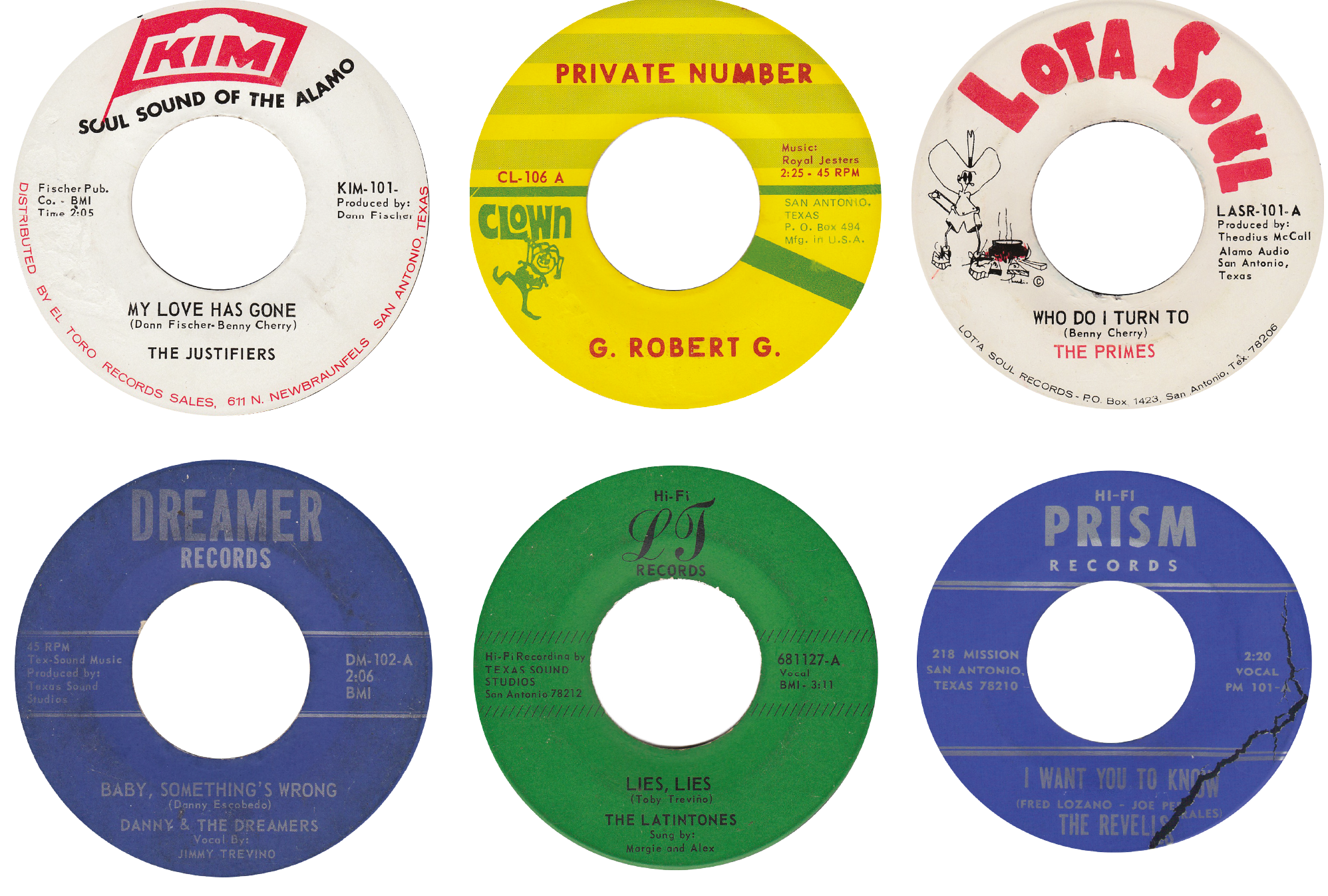
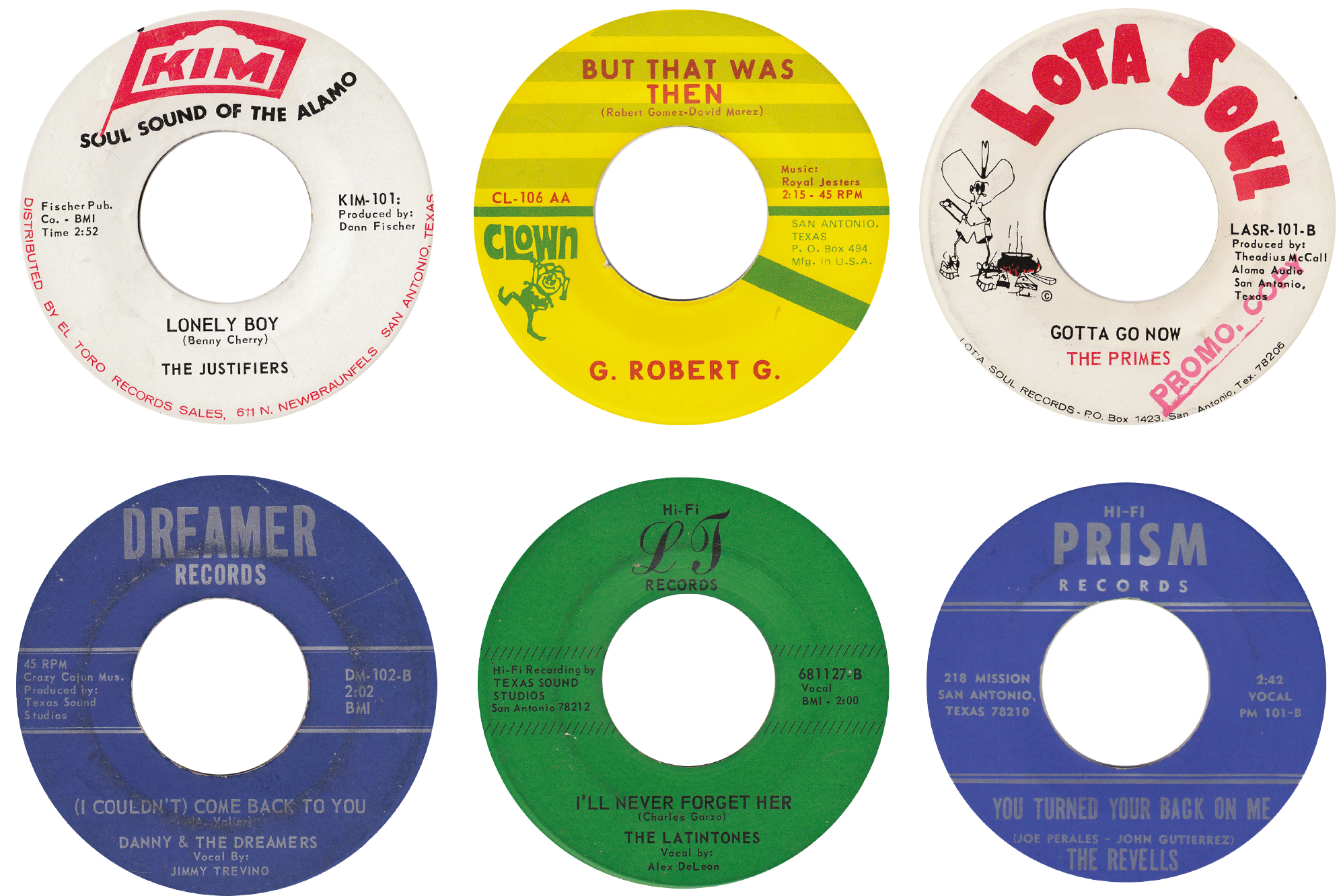
The labels were institutions too, of a smaller and more provisional kind like Kim, Dreamer, Lota Soul, Clown. Prism, and LT. Some of them pressed a handful of sides and closed. Some were a producer with an account at Tanner N Texas Record Pressing (TNT) founded by R.E. “Bob” Tanner. At least one, Lota Soul, carried hand-drawn label art: a caricature of its proprietor beside a pot of fire, signed “Mr. B.T.” for Mr. Bold Texan, a joke told in ink on a record that maybe a few hundred people ever held. What unites these twelve sides is not a sound. It would be dishonest to claim one. The Justifiers are a vocal group working the tenor-heavy harmony language of Chicago, Philly, or Detroit, delivered from the East Side with the polish of men who had studied Spot Barnett and Curly Mays up close. Danny & the Dreamers are a horn band, seven and eight pieces deep, formed by a thirteen-year-old with a Silvertone and an amp built into the case, and they are loud in the specific way that bands who have opened for the Rolling Stones at a livestock coliseum are loud. The LatinTones came up as Los Tropicanos playing regional Mexican music and turned, deliberately, toward Aretha and James Brown.


You can hear the pivot mid-record: two originals cut in under an hour at Jeff Smith’s Texas Sound Studios, the DeLeon siblings’ harmony holding the center. The Revells started as The Radiants, in matching suits, doing Beatles songs in Spanish. G. Robert G. is Robert Gomez, who spent 1964 to 1970 in The Eptones behind David Marez and then made records under his own initials, including an instrumental reading of William Bell’s “Private Number“ that has no business being as good as it is. The Primes are four kids from Wheatley singing songs Bennie Cherry wrote for them. Cherry, of The Justifiers, closed a circle that nobody at the time would have described as a circle.


What unites them is San Antonio, which is less obvious than it sounds. In this city the first question anyone asks a stranger is what high school they went to. Never college. Most American cities of this size are built out of arrivals, Austin among them, and the question would not mean much there. San Antonio is a large city that has never behaved like one. People stay, and those who stay are separated by at most one or two people. Bennie Cherry went to Brackenridge before St. Phillips. So did Joe Perales, and so did several of the LatinTones. Three of the six groups on this record trace back through one high school.
And nobody stayed put. Cherry wrote for The Primes. Perales and Lozano left The Revells for the Eptones, Danny Escobedo joined the Royal Jesters cut “Chévere“ with them, Chris Alaniz came to the LatinTones out of The Epics. Kenneth Koontz of The Primes turned up in The world famous Coasters a decade later. Doug Sahm made it all the way to a studio with Bob Dylan for Doug Sahm and Band in 1973. These are six bands only on paper. In practice it was one roster, reshuffled. A scene’s shape is legible in its transfers.


Proximity came with conditions, and the conditions left marks. Horn sections that lean and sag against the beat, drunk-sounding, arriving a hair behind where they should. Guitars a few cents out and staying that way, because nobody stopped to fix it and the take was good enough. One room, one afternoon, one or two takes, because the studio time was purchased and not granted. Tape pushed until it saturates. A vocal that arrives already tired. These are the conditions of a scene where records were made in the interval between the school day and the gig, and they impose a common weather on twelve sides that share almost nothing else.
Sixty years is a long time for a record to stay in a box. The reasons are ordinary. No distribution, no follow-up, a band that broke up when somebody enlisted, or somebody’s mother said no. Fred Lozano of The Revells became a news anchor on KENS5 for forty years - I still remember him and Dan Cok vividly. Bennie Cherry and Archie Satterfield of the Justifiers sang with The Flamingos (Yes, those Flamingos) in 1984 and still perform around the Las Vegas circuit. These are not tragedies. They are what happens when a regional single doesn’t break, which is what happens to nearly every regional single ever pressed.
But the sides survive, and they do something that major label records often cannot. They carry the room. A listener with any imaginative capacity at all can hear the size of the space, the hour, the number of people standing in it, the fact that everyone present is young and has to be somewhere in the morning. The West Side Sound has been described as a fusion, a demographic, a set of chord changes, an argument about who San Antonio belongs to. Texas Crude proposes something smaller and more durable: that the city’s real signature is proximity, captured accidentally, by kids who were only trying to make something that sounded like the radio.
They did not sound like the radio. That is the whole value.
You can purchase Texas Crude - Alamo City Sides: Raw Soul & Garage From San Antonio 1964-1968 over at our Bandcamp.