


AN ENGLISH-LANGUAGE HOUR
Ricky’s ear and love for music came from his father. Manuel Davila Sr. had been in Texas radio since 1928, when he and his brother bought airtime on English-language stations to broadcast in Spanish to people no one else was reaching. In 1954 he was working KBOP down in Pleasanton on the shift that relieved Willie Nelson’s, and he brought the nine-year-old along to cue records. There were no headphones a boy that size could use, so the kid put his ear flat against the vinyl and found the groove by feel, and Willie - who came back at seven and rode the signal to sunset - remembered him decades afterward as that kid on the floor.
Three years later, Davila and José “Pepino” Villarreal took over KUKA, a Spanish-language station in a city whose English-language outlets, KTSA and KONO among them, had no use whatsoever for the music being made four miles west of their transmitters. In October of 1959 the fathers put their sons on the air: Gilbert Villarreal out of Tech, Manuel Jr. and Ricky Davila out of Brackenridge. Two hours a day, after school, in English, on a Spanish-language signal. They called it Teen’s Choice.
The boys’ Spanish was poor, which turned out to be an asset rather than a liability, because the show’s real product was never language of the records, but the dedications. A KUKA Power Dedication cost a phone call and some guts: you called the station, requested a record, and a name to dedicate the request to, and for two and a half minutes all of San Antonio knew that a boy at Brackenridge loved a girl at Tech very much.
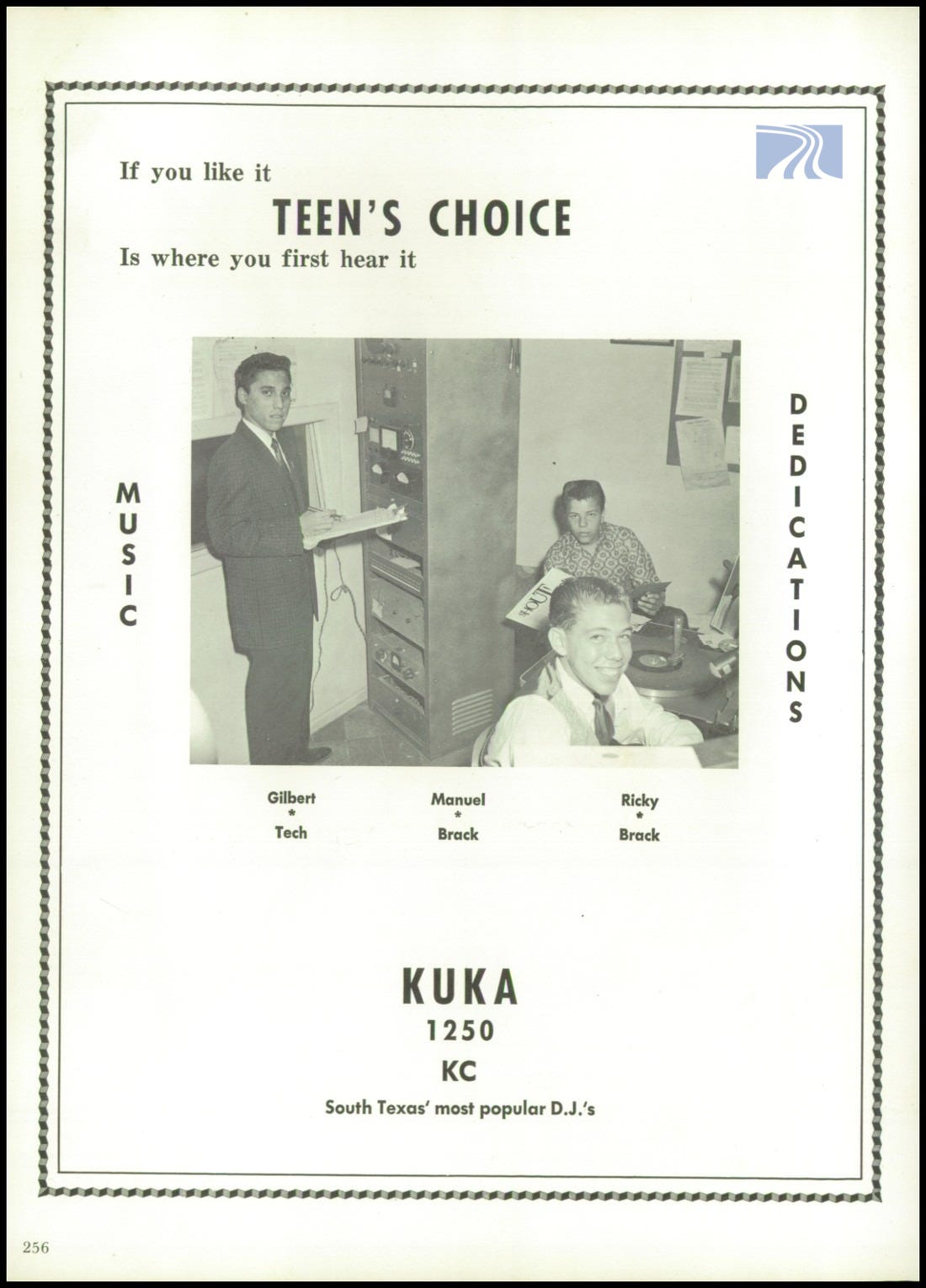
What went out under the dedications was the second half of the argument. They played the national hits, but the weight sat on the Royal Jesters, the Dinos, Vince Cantu and the Rockin’ Dominoes, Sunny Ozuna and the SunGlows, Rudy Tee, the Commands, Doug Sahm - the whole roster the big stations wouldn’t touch. Today, those records and artists are part of the ‘West Side Sound’ canon. What the three of them did was put the music into the air first and keep it there daily at an hour when the audience for it was home from school and listening.
A show like that does not stay in the studio. They MC’d sock hops at Brackenridge and Tech and Lanier, sometimes hauling a live band along; they plugged the weekly car-club dances at the Patio Andaluz on Commerce and Colorado; they filled Municipal Auditorium with Teen’s Choice concerts, the first of which billed Rudy & the Reno Bops and Butch & the Twilighters alongside a white kid with a pompadour promoting a record called “Why, Why, Why,” on Joe Anthony’s Harlem Records - that kid was Doug Sahm, and it was the kind of record the show kept playing.
Doctor Soul on the USS Saratoga
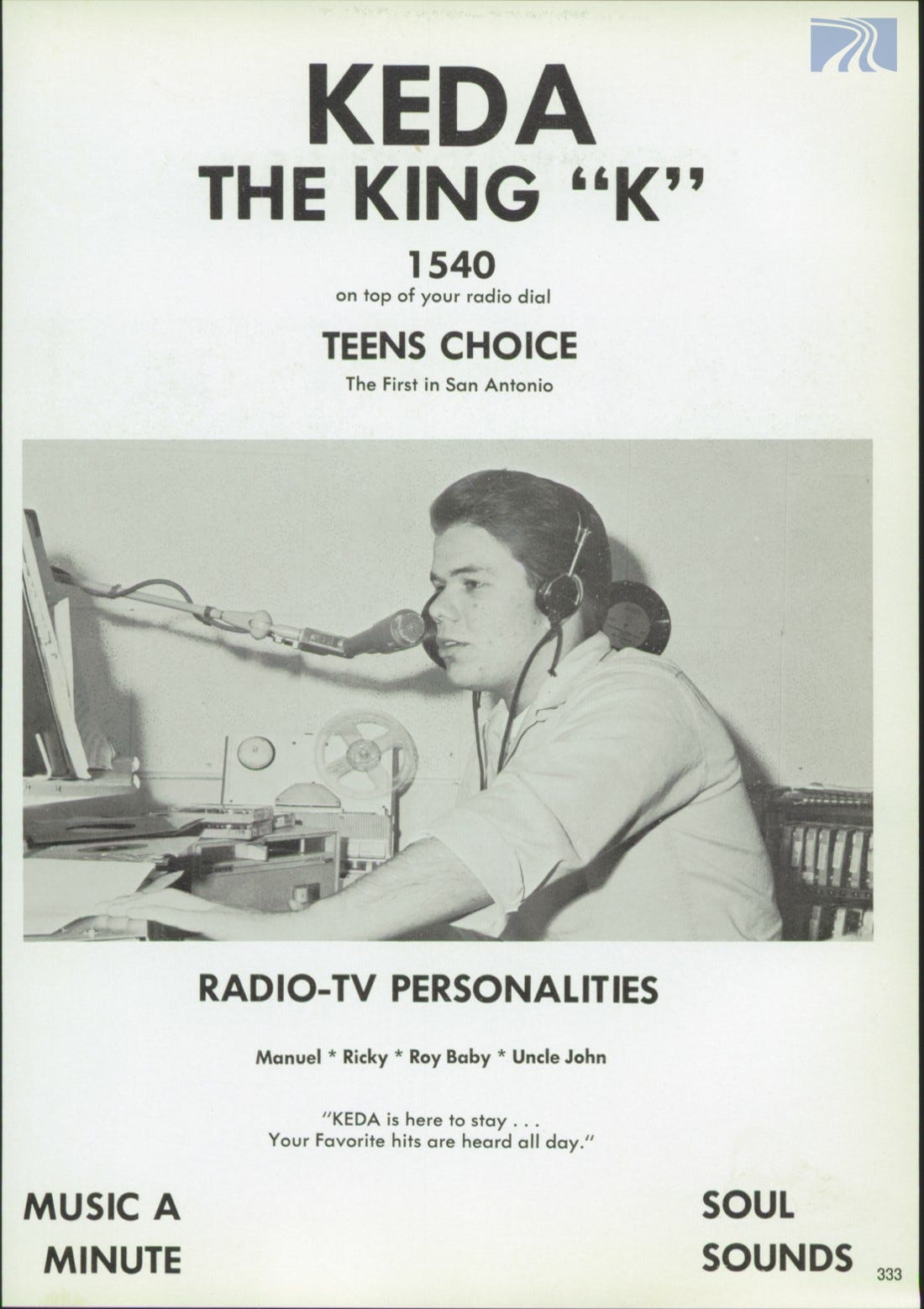
Ricky was two years behind his brother. He graduated from Brackenridge in 1964, enlisted in the Naval Reserve that fall, and a year later they called him up. He served two years’ active duty aboard the USS Saratoga, a thirty-six-thousand-ton aircraft carrier in the Mediterranean, and he took the radio with him. Onboard, he broadcast as Doctor Soul, “this is Doctor Soul on the scene with my record machine,” which is the sound of a nineteen-year-old who has already been a professional for a decade. The sea duty did what sea duty does: it left him with nothing to do during the hours, so he started writing.
The founding scene of his recording career is a sailor in a bunk with a flashlight, a guitar, and a sheet of paper he can barely see, working out “Laughing To Keep From Crying,” when another sailor comes over to ask who wrote that. Salvatore Sabino was from Queens and had a high, sweet voice, and the two of them became a duo that never performed in public once.
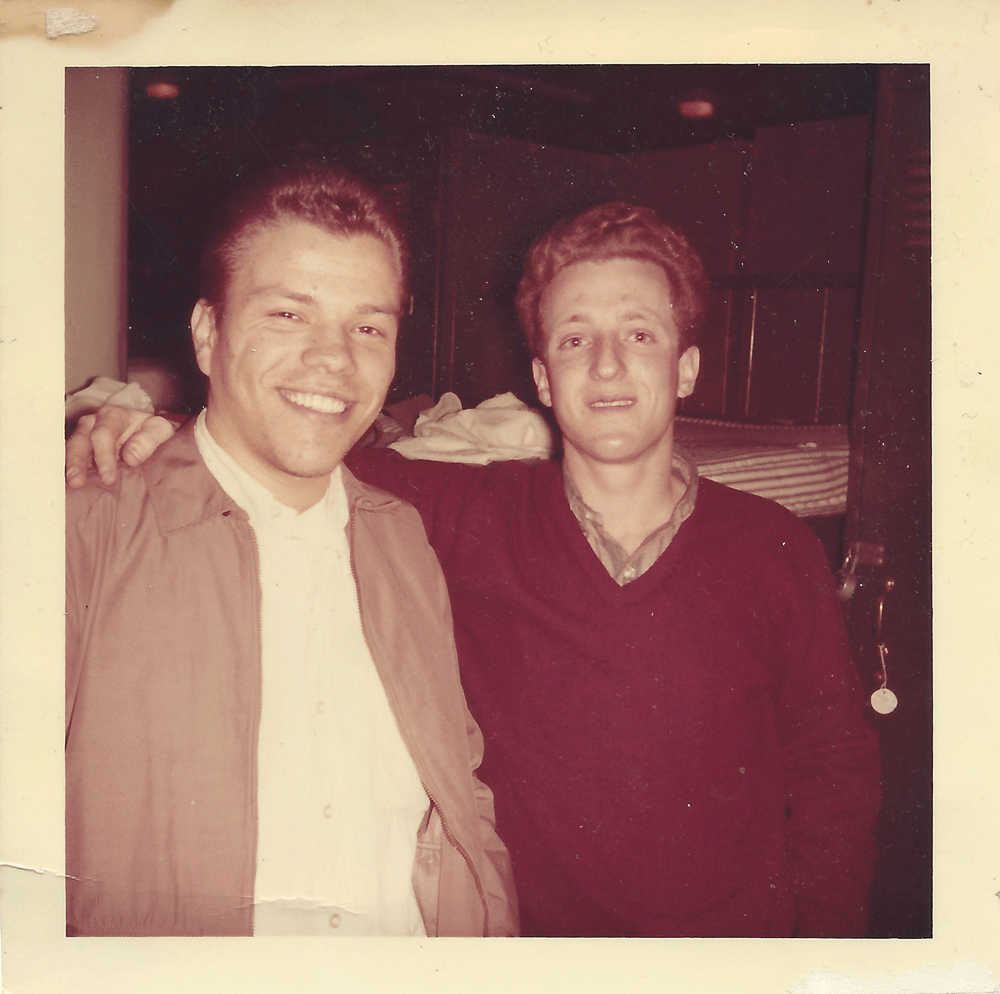
Ricky was home on holiday leave in January 1967, and he spent it the way he spent everything. He bought a copy of the Commands’ “No Time For You“ for his DJ box, a San Antonio record bought by a San Antonio sailor and carried back across an ocean. And he walked into Abe Epstein’s studio and cut “You Were My Everything“ b/w “The Day I Found You“ for the family’s Teen’s Choice label, backed by the Laveers, billed as Ricky Davila. The family had by then turned the radio show into a record label, and the label’s most obscure artist was the boy the show had been built around. That single is the hinge of his whole discography, and almost nobody has heard it.


Doc & Sal took the songs to Abe Epstein, a San Antonio real-estate man who ran nine record labels on the side. The most particular of them was Dynamic: twenty singles of sweet soul and close vocal harmony cut in the late sixties, a catalog with almost nothing weak in it, and a duo of two voices in close harmony was exactly what it was built to press. He heard “Laughing To Keep From Crying,” offered to release it on the spot, leaked a single-sided promotional pressing to radio, and on the strength of the airplay hung the duo on a week of dates opening for James & Bobby Purify, Corpus Christi to Houston to Dallas to El Paso, the Tear Drops backing them.


Hearing “I’m Your Puppet” every night for a week is what produced “Can’t Get You Offa My Mind.“ Davila wrote it as a rebuttal and offered it to the Purifys, who said they’d cut it when they got home. He later told Sal, “Hey, they’re lying through their crooked teeth, so let’s go into the studio and record this.” Epstein gave it a proper issue as 121 on the Dynamic imprint. The final session, a few weeks before Halloween in 1968, is the one where Epstein opened the wallet: the Royal Jesters as the band, Lavine Elias on Hammond, Robert Gomez on guitar, and a member of the San Antonio Symphony brought in at union scale to play violin, pizzicato, running ragged alongside the organ on the Sabino feature of Harvey Averne’s “My Dream,” b/w “Cry And Wonder Why.” The cut is an unusually expensive-sounding record for a label that size (Epstein did this for the Dreamliners, too), and it is the last thing the two of them ever made. Both singles came out that November, sold mostly in town, and sales were flat by Christmas. Doc and Sal stayed in touch for thirty years, but never reunited in person or behind a mic.


The records did not fail because they were poor in sales or airplay. They failed the way regional soul records failed, which is to say, in distribution, timing, and mostly insularity.
Güero Polkas: The Second Name
The name that buried the first one came out of a playful jab. Humberto Lozano López, who broadcast as Capirucha, walked into the studio one day, corrected a word Davila had mangled, turned to his father and called him ‘ese pinche güero polkero,’ that pale kid who plays polkas, and Davila, with the instinct of a man who has never once let a good line go by, started opening his shifts with ‘les habla el güero polkero.’ Chalito Johnson told him to knock it off. Manny Guerra sanded it down to Güero Polkas, and that was that for the next four decades.
Forty-four years at KEDA, his father’s station on South Flores, playing conjunto next to rock ‘n’ roll next to blues next to R&B, heavy on South Texas, ordered by nothing but his own read of the room. It was the kind of ear that never needed a consultant to identify a hit. The voiceovers went out drenched in echo, and the commercials went out unhinged for forty years running; it was a signal that sounded like one person talking rather than a job. The station read obituaries on the air. It ran plate sales to bury people whose families couldn’t afford it. “Who else anymore is going to have a plate sale to help bury somebody,” Ricky said the morning he signed off for the last time. “That’s how we helped.”
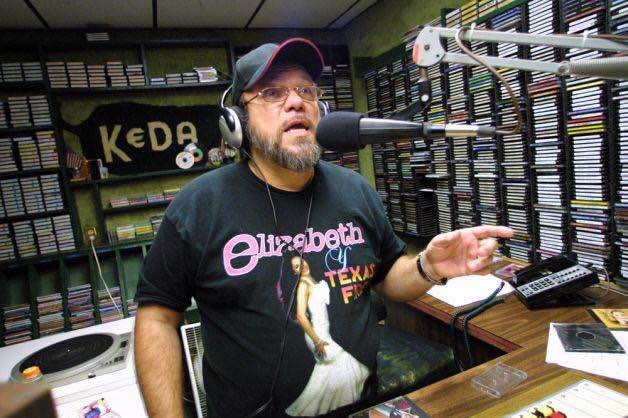
He took the last shift on July 29, 2011, six to ten, opening with Flaco Jiménez and closing with Los Fantasmas, trying, he said afterward, to play everybody he had ever actually met and worked with. Then he put in the last disc, hit play, and walked out without saying anything.
It is fair to ask what the West Side Sound would amount to now without him, and the people best placed to answer settled it years ago. Flaco Jiménez was too ill to come to the final broadcast and sent a note over by hand: “if it wasn’t for Güero Polkas, there would be no Flaco Jiménez.” Rudy Tee Gonzales came in person that morning and said that next to God, without the station they would all have been nowhere. Gilbert Rodríguez framed it as policy rather than sentiment, which is nearer the truth of it: what endeared KEDA to people was that everybody got a chance, famous or not. A regional music has to be audible somewhere before it can become a regional music, and for four decades an enormous share of what people now call the West Side Sound was heard first, or heard at all, because Ricky Davila decided to put it on.
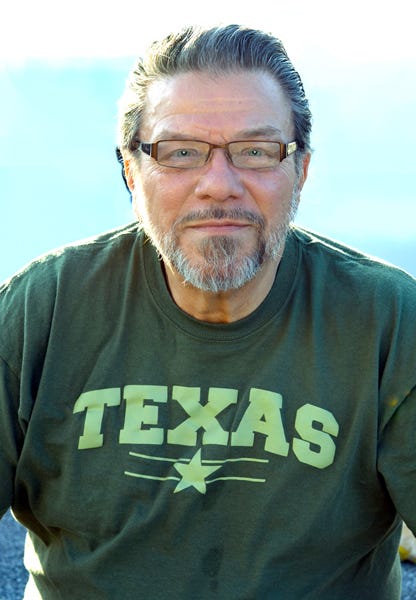
He wrote something like half a dozen songs and then stopped, and spent the next forty-four years choosing other people’s instead. The obituaries are not wrong to lead with the second name. Four decades is four decades, but the sides are the tell. They are the one place in the record where you can watch him doing deliberately, with a pen, what he spent the rest of his life doing by reflex: putting the right thing on at the right moment for somebody who needed to hear it.
He learned that trick at nine years old with his ear against the floor. He never had to learn another one.