


Long before the “West Side Sound” became a shorthand or a genre tag, it was just a sound-unfolding softly in school dances, ballrooms, and sock hops across San Antonio. It surfaced from the shared spaces across San Antonio, where young Mexican musicians forged identity through sound. The Royal Jesters began their journey in 1958, making them amongst the sound’s earliest architects. The founding voices of the Royal Jesters belonged to Oscar Lawson and Henry Hernandez, two West Side kids who first met singing in a church youth choir. Henry came from a musical home-his father played everything from piano to trumpet-while Oscar, soft-spoken but self-assured, taught himself guitar. They both attended Lanier High School, known locally as the “Pride of the West Side,” and sang in separate groups: Henry with the Five Angels, and Oscar with the Young Ones.
Oscar, a year ahead of Henry, briefly attended seminary school in Louisiana after graduating. But once he returned to San Antonio, the two reconnected and decided to start something of their own. The group they formed would eventually become the Royal Jesters—a name stitched together with the same mix of dignity and playfulness that defined their sound. “Back in those days, everything was ‘Royal’—the Royal Tones, the Royal Knights, the Royal this and that,” Henry Hernandez recalled. “Some of us wanted something classy, like ‘The Royals,’ and others were leaning toward something fun, like ‘The Jesters.’ So we just put ‘em together— Royal Jesters. That’s who we were.” Not long after, Henry and Oscar brought in their friends Mike Pedraza and Bobby Cantu. Pedraza then recruited Charlie Walker, an African American student from the East Side who attended Fox Tech High School to learn a trade. The group reflected the spirit of a newly integrating city, united by a shared love for doo-wop, flooding the airwaves of local radio station KMAC.
flooding the airwaves of local radio station KMAC.
By 1960, the Royal Jesters had already become a fixture in San Antonio’s west side soundscape. They had recorded with local DJ Joe Anthony on his Harlem label, landing regional attention with “My Angel of Love” and “Those Dreamy Eyes”-two songs penned by Oscar Lawson, aired relentlessly on the radio, but never followed by a royalty check. Anthony was slick with words, and when Oscar and Henry pressed him about compensation, he flipped the situation into a live radio appearance, announcing their presence on-air. The Jesters left without payment, but with a bigger local profile. With that shift came changes-Mike and Bobby exited the group, and a few lineup experiments followed—but it wasn’t until Louie Escalante and Dimas Garza joined the group that things started to click.
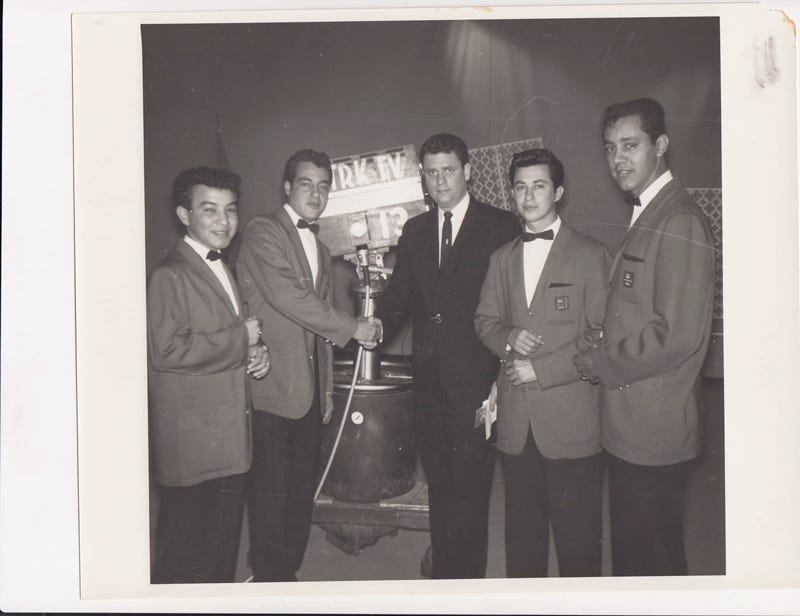
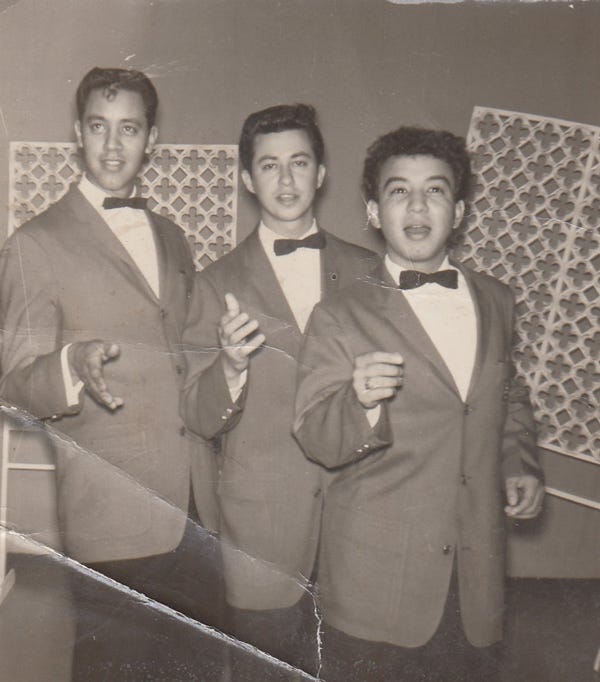
Louie, a popular basketball star from Lanier with no singing background, was brought into the group. “He didn’t really sing at first,” Henry said, “but he learned and just fit-he became part of the harmony.’‘ Not long after, Henry left for military duty, the group invited Dimas Garza to step in. Dimas had been singing with the Lyrics, a rival group also signed to Joe Anthony’s Harlem label, and had already recorded a single with another group called the Kool-Dips. With Oscar, Henry, Louie, and Dimas in place, the Jesters found a new groove-a steady vocal unit with chemistry, style, and soul. This became the core crew that recorded some of their most memorable singles during the early years of Epstein Enterprises.
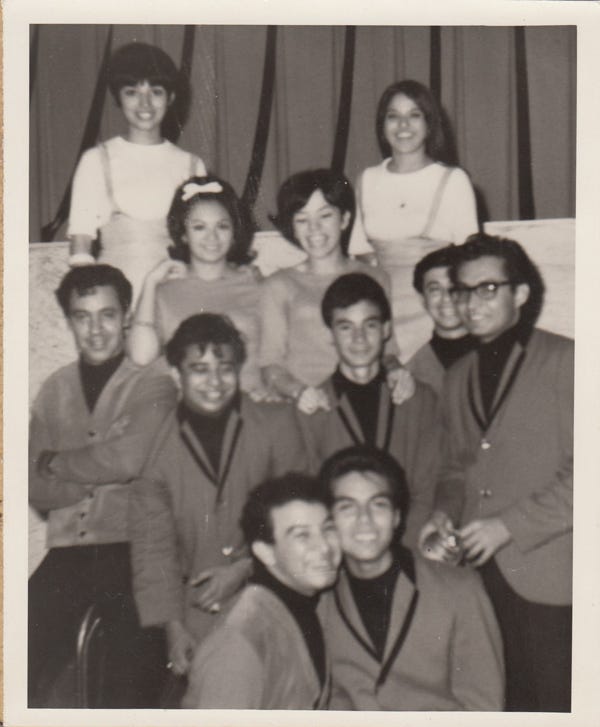
As the group transitioned to Epstein’s Cobra and Jox labels, they recorded a string of English-language singles, including “Let’s Kiss And Make Up” b/w “Love Me” and “Never Will Forget” b/w “I Want To Be Loved.” Both singles were penned by Dimas himself. This lineup-Oscar, Louie, Henry (once he returned), and Dimas-would go on to define the Royal Jesters’ classic era, cementing their place in San Antonio music history. The singles earned modest national attention-three-star reviews in Billboard and steady airplay back home-but once again, the group found themselves facing broken promises and missing royalties. Tired of waiting on checks that never came, the Jesters decided to pursue their own business ventures.
Around 1965, they founded their own imprints—Jester Records and Clown Records—to control their recordings and carve out a future on their own terms. Despite leaving Abe Epstein’s Cobra and Jox labels behind, the split wasn’t bitter. The group recorded at Epstein’s studio located on General McMullen, and even assisted on a slew of singles that captured the group in its prime. The band found its footing in this era, locking into a rhythm section that felt both sharp and soulful. Charlie Cruz held down the bass, with Ignacio “Pache” De La Vega on guitar, Manuel “Bones” Aragon on drums, Luvine Elias Jr. on organ, Tony Peña adding also on bass, and a horn section led by Victor Alvarado and Jerry Aguirre on trumpet, and Alex Hernandez on tenor sax. “At first, I wasn’t sure,” said Bones, the longest-tenured member of the Royal Jesters. “I came from a different scene.
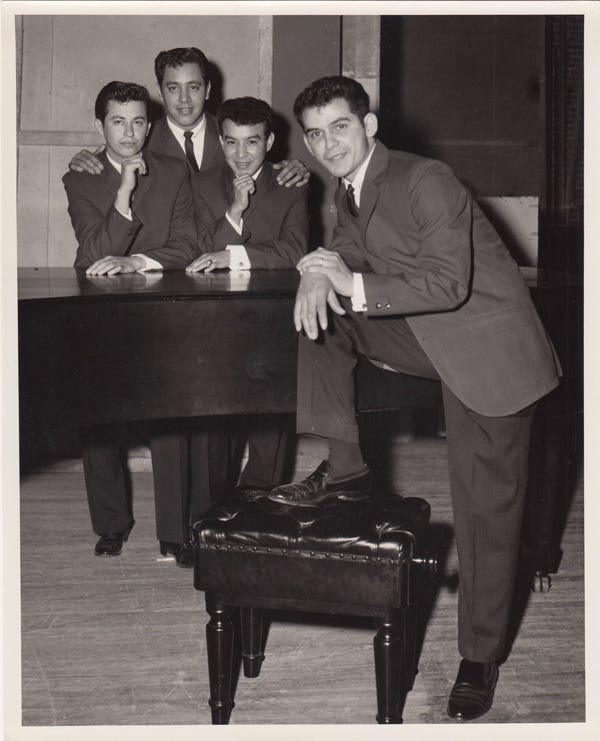
But they won me over—they were just locked in.” His favorite memory of the band’s energy? “A tight groove you didn’t want to fall out of. And if you didn’t wear the right suit or tie, they’d fine us!” One night, Henry told Bones he would open the set solo with a cover of Herbie Hancock’s “Watermelon Man.” No warning, and his only cue was, “Trust me.” Bones was nervous. But as he started playing, the crowd leaned in, and one by one, the band crept onstage behind him, layering the sound. By the time they hit full stride, the place was electric. Henry looked back at Bones with a smirk that said, See? I told you. Like many from those years, that moment stuck with Bones—clear as a soundcheck and full of soft nostalgia. It was also when Dimas began exploring his own sound. His solo work on the group’s Clown imprint was sparked by ambition and love. His wife, Gloria, wanted him closer to home, away from the late nights and smoke-filled bars. But Dimas never drifted far; he shared stages and studio time with the Jesters, and their musical bond remained intact.
In 1965, the Royal Jesters released their debut LP, We Go Together - an album of flawless harmonies, a powerful rhythm section, swirling organ, and heavy, soulful drums. The album leaned heavily on covers and a few instrumental cuts, with most tracks featuring the group harmonizing together behind Louie Escalante’s smooth baritone lead. But each member had their own moment to shine: Oscar took the lead on “Funny (Not Much),” Henry on “I Want To Meet Her,” and Louie again on “I’ll Be Home” - a heartfelt tribute to their brothers serving in the military, complete with a solemn taps intro. The album featured an instrumental cover ofMongo Santamaria’s “Afro-Lypso,” as well as an original composition by Luvine Elias Jr. titled “Stiletto-135.” The track was born from a harrowing experience: after being stabbed one night following a gig, Luvine began carrying a stiletto knife for protection. Not long after, he and his buddies were pulled over for speeding while on a road trip to visit a friend’s father. “I put the knife underneath the seat,” Luvine recalled. “when the cop found it, he said, ‘whoever owns this, confess now, or I’m taking everyone in.’ so I confessed, spent the night in jail, and paid a $135 fine. That’s how the song got its name.’‘ The album’s visual presentation came together through a tightly knit web of local talent. The cover was designed by Sosart, Bob Tanner’s go-to design team at TNT Records, while the photograph was taken by Zintgraff Photographers - a company where Louie Escalante, working part-time in the darkroom, may have helped develop the very image chosen for the sleeve.
Riding the momentum of their new ventures - and drawing on their natural business instincts - the Royal Jesters leased the now-legendary Patio Andaluz, a venue they called home for the next three years. In the heart of the west side of San Antonio, the Jesters curated a vibrant calendar of dances and sock hops complete with car clubs and live performances, offering a stage to some of San Antonio’s best local acts, like Henry & the Kasuals, The Eptones, Little Jr. Jesse and the Teardrops, and of course the king himself, Sunny & the Sunliners. Manuel Betancourt, a close friend of the Jesters, promoter, and the leader of the Road Griffins car club, recalls, “I would book nights with Oscar and Henry and invite all the car clubs in the city. There would be hundreds of people with lines wrapping around the corner waiting to get in - we had a nice thing going.” That thing did come to an end in 1968 when Henry and Louie got into a disagreement that ended with punches being thrown just before a gig. That incident led to Louie’s departure from the group, and the Jesters brought in David Marez-a former football standout and lead singer of the Eptones-to take his place.


Around that time, Oscar shifted into a behind-the-scenes role, focusing on production and management, while Henry stepped forward as the group’s bandleader. The Royal Jesters underwent several lineup changes in the following years, bringing in heavyweights from the San Antonio scene, including Joe Jama (of the Revells and the Eptones), Jack Martinez (of the Commands), and the soulful Ralph Cortez. Their follow-up LP, Chevere, was released on a new Jester imprint called Optimum Records. Three more albums followed on Manny Guerra’s GCP label, but by the mid-1970s, the group stepped away from the spotlight. It wasn’t until the next millennium in 2005 that Oscar, Henry, and David reunited to record Odyssey: The Journey - a release earned the group their first Grammy nomination-and gave the Royal Jesters one more moment in the sun.
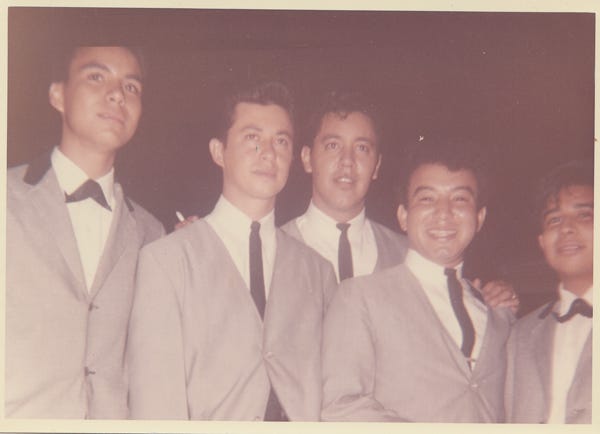
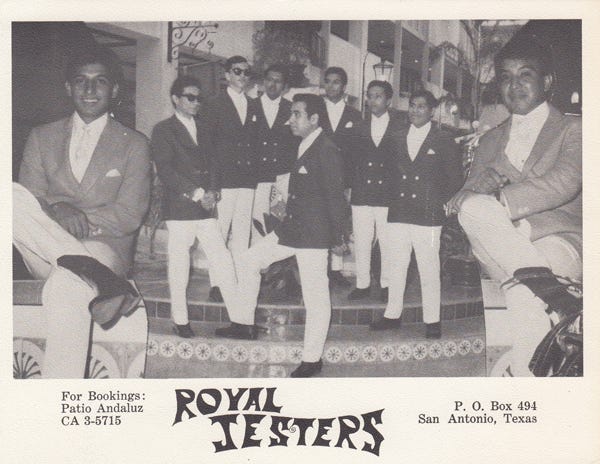
This reissue arrives 60 years after We Go Together first made its quiet debut. Oscar Lawson passed in 2011, Dimas Garza in 2008, and Louie Escalante in early 2025. Henry Hernandez-the last original Jester standing, now in his eighties-still speaks of the music and those years with joy, fondness, and a quiet pride. Henry and Louie stayed close friends and would talk daily until his passing. Many of the Jesters’ band members have since passed, but their presence lingers-they’re honored at oldies dances and remembered in stories shared over breakfast meetups at taco shops across the city. Though San Antonio has grown and reshaped itself over the decades, the essence of the world that produced this music still lingers in the intimate memories of those who lived it. If you’re holding this, you’re holding a piece of that enduring memory.
- Rae Cabello I Pecos Records
We Go Together personnel:
The Royal Jesters | Oscar Lawson, Henry Hernandez, & Louie Escalante.
The Royal Jesters Band I Igancio “Pache” De La Vega (Guitar), Chale Cruz (Bass), Manuel “Bones” Aragon (Drums), Luvine Elias Jr. (Organ & Keyboard), Tony Pefia (Bass), Victor Alvarado (Trumpet), Jerry Aguirre {Trumpet), and Alex Hernandez (Sax).
Acknowledgments and gratitude: Rob Sevier & Ken Shipley at the Numero Group for all their guidance and support. Jesse Garcia, Ruben Molina, Chris Varelas, Jason Chronis, Rosemary & the Lawson family, Luis “Dino” Escalante Jr., and Henry Hernandez.